

How to tie a canoe onto your car (without looking like a Rookie)
Tying a canoe onto a car may seem fairly straightforward, but if you don't get it right your boat will be a safety hazard. Too often we hear of canoes flying off on the highway, which puts everyone in danger.
The good news? Tying a canoe safely onto your car isn’t complicated once you know the steps. With the right gear (and one great knot), you’ll look like you’ve been doing this for years—and your canoe will arrive safely every time.
What You’ll Need
- Roof rack or foam blocks (roof rack is best; foam blocks are a solid backup)
- Cam buckle straps and/or strong rope
- Bow and stern tie-downs (or hood loops if your car doesn’t have anchor points)
- Safety flag if the canoe extends more than 1.5 m / 5 ft beyond your car
Pro tips:
- Use polyester marine rope (like double-braid). It won’t stretch when wet. Yacht Braid (1/4") is a good rope to start with.
- Do NOT use ratchet straps. They can easily crack your boat hull, we've seen it happen.
Step 1: Prep Your Vehicle
- Best setup: After-market roof rack (like Thule or Yakima) with canoe brackets.
- Good enough: Factory crossbars.
- No rack? Use foam blocks. Place them just behind the windshield and near the back of the roof where it is strongest. If the roof flexes when you press it with your hand, don’t put a block there.
Step 2: Position the Canoe
Centre the canoe so the yoke (or middle thwart) is halfway between your supports. Balanced = stable.

Step 3: Strap It Down Across the Middle
- Loop straps or ropes over the canoe and secure them to the rack—or, if you’re using foam blocks, run them through your doors (not windows).
- Pull tight enough that the canoe doesn’t slide, but don’t crank so hard that you crack fiberglass or warp a plastic hull.
- If you’re using cam straps, always tie down the loose ends so they don’t whip in the wind.

Step 4: Secure the Bow (and Stern if Needed)
This step is critical—it keeps the canoe from shifting forward or sideways in the wind, and acts as a safety line if your rack fails.
- Tie the bow down to two points on the front of your vehicle, creating a triangle.
- Avoid plastic parts or anything that gets hot (like your exhaust).
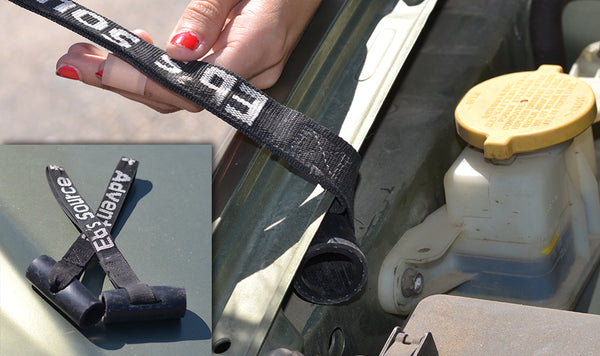
- No anchor points? Use hood loops—simple straps attached to PVC pipe that close under your hood to create sturdy tie-down spots.
- Using foam blocks? Secure the stern too, for extra stability. You can put a hood loop under a hatch or trunk door if you don't have a tie-down point back there.
Step 5: Learn the Trucker’s Hitch (Your MacGyver Moment)
The Trucker’s Hitch is one of the most useful knots you’ll ever learn. Think of it as a pulley system built into your rope—giving you tons of leverage to cinch everything down tight. You can use this knot to tighten your bow and stern ropes, tie tarps to trees when camping, and strap down loads. It is a GREAT knot to know.

How to do a Trucker's Hitch:
- About halfway down your rope, make a small loop and twist it.
- Take a bight (a loop of rope) from the free end and poke it through your first loop.
- Pull to tighten—you’ve just made your pulley point.
- Pass the free end down through your car’s anchor point and back up through the pulley loop.
- Pull tight (you’ll be amazed at the leverage).
- Pinch, then finish with two half-hitches to lock it off.
- Tie off extra rope so it doesn’t flap and distract you while driving.

Step 6: Safety Check
- If the canoe sticks out more than 1.5 m / 5 ft beyond your vehicle, attach a red safety flag so you're legal. It also saves you from walking into your own boat end (happens more often than you think).
- Do a final check before you drive: straps snug, knots secure, no loose ends.
Pro tip: Give the canoe a shove side to side. If your car moves but the canoe doesn’t, you’ve done it right.

There you go—you’ve just learned the simplest, safest way to tie a canoe to your car. Next time you head for the water you’ll know what you’re doing. Beware—you may be asked to tie everyone else's boat down once they know you're a pro.
(Want to see it in action? Scroll down for some helpful videos featuring our own MacGyver, Jeff.)
Comments
Leave a comment